
Camille Pissarro
1830 - 1903
Paysanne bêchant
Ink and pencil on paper
14.1 x 9 cm (5 ¹/₂ x 3 ¹/₂ inches)
Stamped lower right, C.P
Executed circa late 1880s–early 1890s
14.1 x 9 cm (5 ¹/₂ x 3 ¹/₂ inches)
Stamped lower right, C.P
Executed circa late 1880s–early 1890s


Schoneman Galleries Inc, New York
Private collection, USA
Private collection, USA
This work is accompanied by a letter confirming the authenticity of the work by Dr. Joachim Pissarro and will be included in the forthcoming Catalogue Raisonné of Drawings by Camille Pissarro.
This original artwork by Camille Pissarro is available for immediate purchase.
This original artwork by Camille Pissarro is available for immediate purchase.
Camille Pissarro
biography
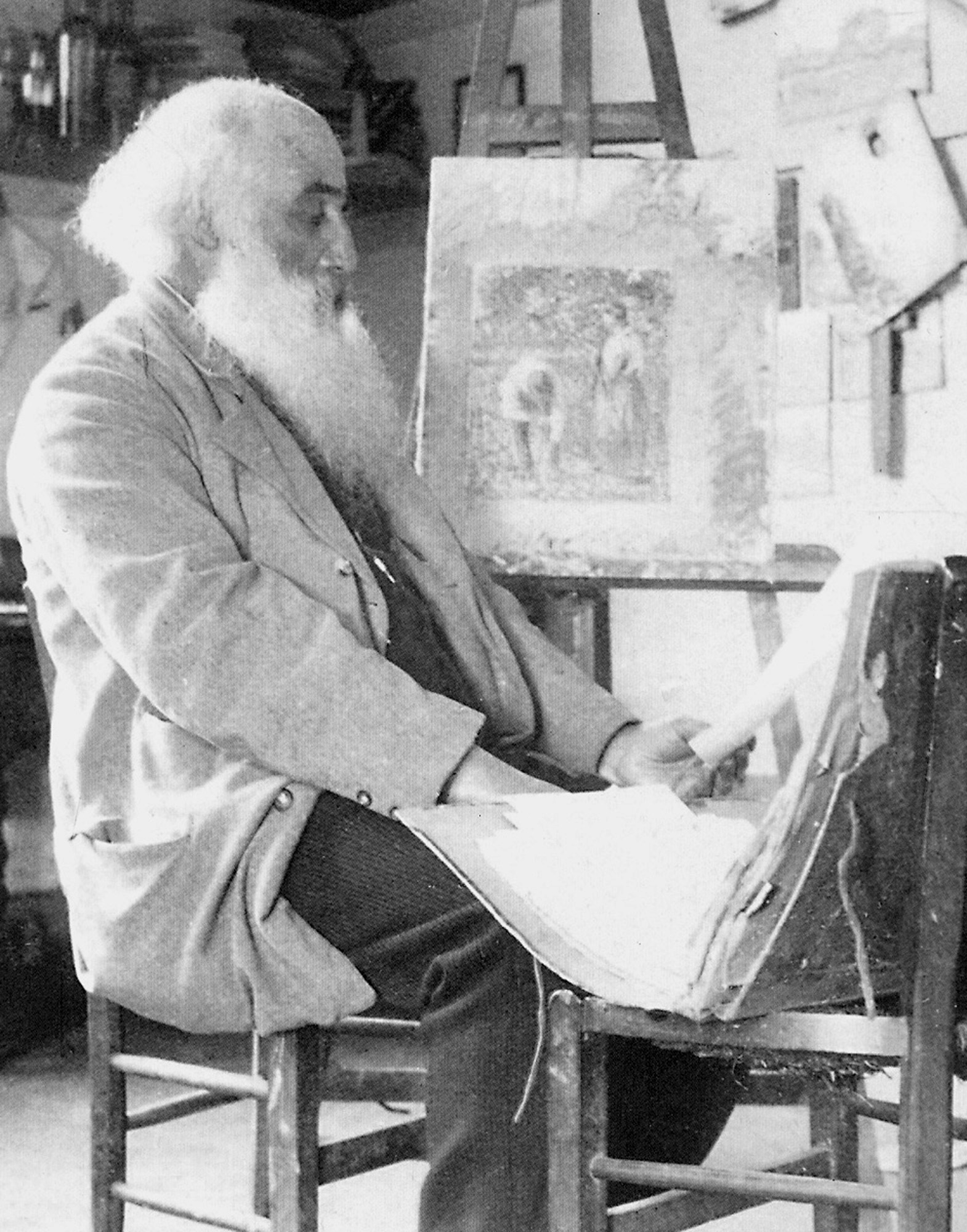
Camille Pissarro was one of the most influential members of the French Impressionist movement. Born on 10 July 1830 in the Danish colony of Saint Thomas, he was the son of Frédéric and Rachel Pissarro. At the age of twelve he was sent to school in Paris, where he displayed a penchant for drawing. His parents disapproved of his interest in art, and in 1852 he left the island with the Danish artist Fritz Melbye to spend eighteen months in Venezuela. After a brief return to Saint Thomas he moved to Paris in 1855 to study at the Académie Suisse, where he began to form relationships with many of the artists who would shape the Impressionist circle, including Claude Monet, Paul Cézanne, Édouard Manet and Pierre Auguste Renoir.
In 1869 Camille moved to Louveciennes. The outbreak of the Franco-Prussian War in 1870 prompted him to relocate to London, where he painted a series of landscapes around Norwood and Crystal Palace. Camille and his close friend Claude Monet, also in London, visited museums together and studied the tradition of British landscape painting. It was also in London that he married Julie Vellay, with whom he would have seven children. On returning to Louveciennes in June 1871, Camille found that many of the works he had left in his house had been lost or damaged during the war.
Camille settled in Pontoise with Julie in 1871, remaining for the next ten years and gathering a close circle of friends around him. There he continued to build his relationships with Cézanne, Monet, Renoir and Degas, and expressed a desire to create an alternative to the Salon. This reflected a wish to break from the rigid tradition of French academic painting, as Camille believed that he and his peers deserved recognition for the new tradition they were shaping. Cézanne repeatedly stayed with Camille and indebted to his example, learned to study nature more patietly, even copying one of Camille's landscapes in order to understand his technique.
The first Impressionist group exhibition in 1874 drew considerable criticism. Camille was the only artist to exhibit in all eight Impressionist exhibitions, the last of which took place in 1886. His principal subject during these years was the rural landscape, in which he often emphasised the idealism of life in the countryside. He regarded peasants and their land as largely untouched by the corruption of industrialisation and admired the figures in these scenes as a symbol of innocence and purity in an age of violent change.
Paul Gauguin was one of the few collectors to show interest in Camille's work. Having acquired a small collection of Impressionist works, he turned to Camille for advice on becoming a painter himself and, for several years, closely followed his mentor. Although their friendship was fraught with disagreement and misunderstanding, Gauguin wrote shortl before Camille's death in 1903: “He was one of my masters, and I do not deny him.”
In the early 1880s Camille moved from Pontoise to nearby Osny, before settling in 1884 in Éragny-sur-Epte, a small village northwest of Paris. In 1885 he met Paul Signac and Georges Seurat, having been introduced by his eldest son Lucien. Camille was fascinated by their efforts to replace the intuitive approach of the Impressionists with the “Divisionist” method, a scientific study of nature's phenomena based on optical laws, and, despite having reached his mid-fifties, he did not hesitate to follow the two younger artists. After a few years, however, he felt restricted by Seurat's theories and returned to a more spontaneous technique, while retaining the lightness and purity of colour acquired during his Divisionist phase.
In his final years Camille divided his time between Paris, Rouen, Le Havre and Éragny, continuing to explore the varying effects of light and weather in a number of series. Many of these paintings are regarded among his finest, and his Paris street scenes have become one of the most sought-after themes in his oeuvre. By the time of his death in 1903, Camille's career was flourishing and he had gained wide recognition. Today his work is held in majo museums around the world.
Camille Pissarro
biography
you may also like

Camille Pissarro
1830 - 1903
L'Anse des Pilotes, après-midi, temps ensoleillé, Le Havre
Oil on canvas
46 x 55 cm (18 ¹/₈ x 21 ⁵/₈ inches)
46 x 55 cm (18 ¹/₈ x 21 ⁵/₈ inches)

Camille Pissarro
1830 - 1903
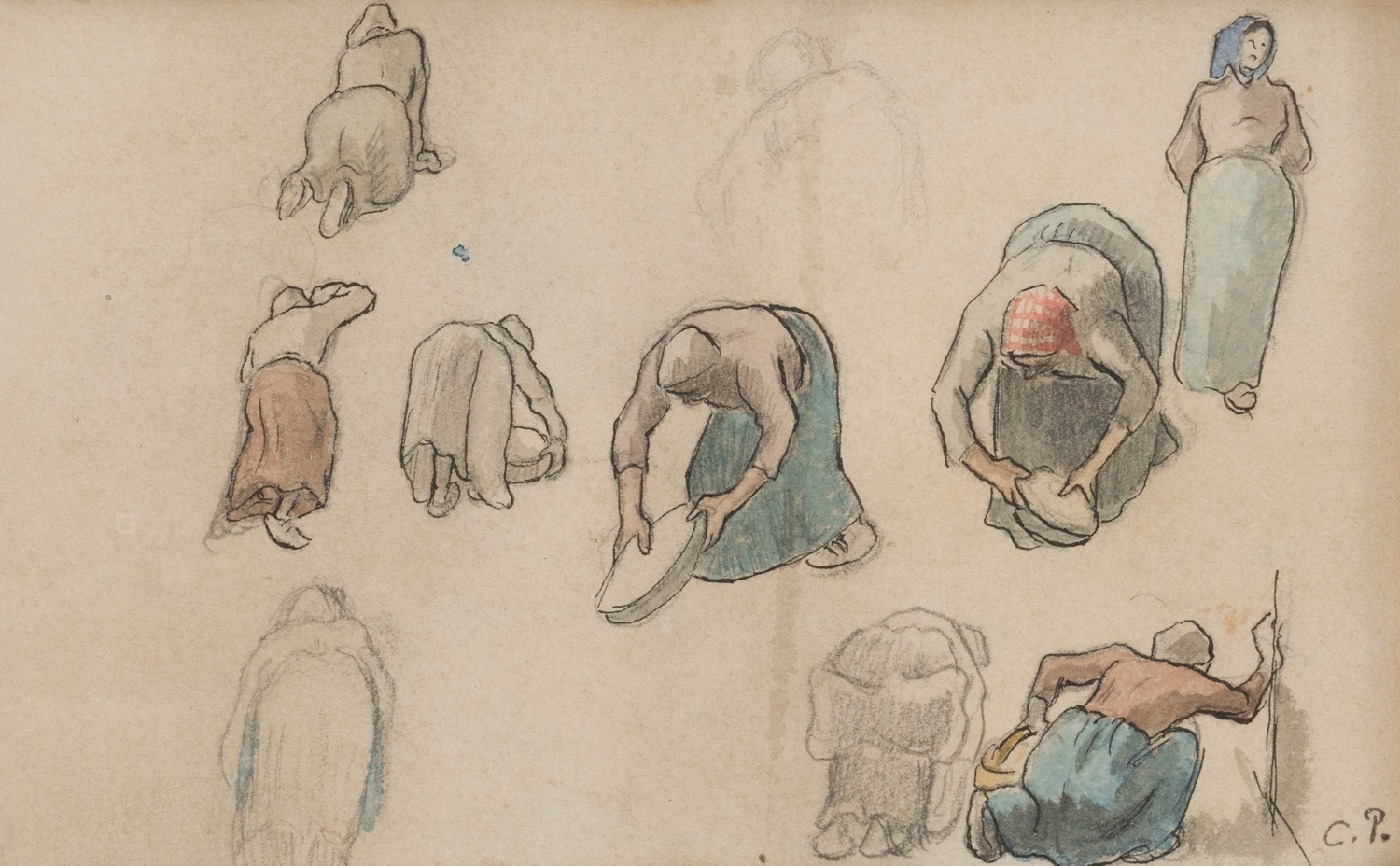
Études de paysannes
Watercolour and charcoal on paper
14 x 22.2 cm (5 ¹/₂ x 8 ³/₄ inches)
14 x 22.2 cm (5 ¹/₂ x 8 ³/₄ inches)

Camille Pissarro
1830 - 1903
Chemin sous bois, à Pontoise
Etching and aquatint
16 x 21.2 cm (6 ¹/₄ x 8 ³/₈ inches)
16 x 21.2 cm (6 ¹/₄ x 8 ³/₈ inches)

Camille Pissarro
1830 - 1903
Paysanne creusant
Ink and pencil on paper
12.5 x 9.8 cm (4 ⁷/₈ x 3 ⁷/₈ inches)
12.5 x 9.8 cm (4 ⁷/₈ x 3 ⁷/₈ inches)

