
Victor Vasarely
1906 - 1997
Aubouda
Acrylic on canvas
68 x 68 cm (26 ³/₄ x 26 ³/₄ inches)
Signed lower centre, Vasarely
Titled on the overlap
Signed, titled and dated on the reverse, VASARELY AUBOUDA 1985 Vasarely
68 x 68 cm (26 ³/₄ x 26 ³/₄ inches)
Signed lower centre, Vasarely
Titled on the overlap
Signed, titled and dated on the reverse, VASARELY AUBOUDA 1985 Vasarely


Private collection
Stockholms Auktionsverk, Stockholm, 1999
Private collection
Dorotheum, Vienna, 2000
Heather James Fine Art, New York
Private collection, acquired from the above
Stockholms Auktionsverk, Stockholm, 1999
Private collection
Dorotheum, Vienna, 2000
Heather James Fine Art, New York
Private collection, acquired from the above
This work is accompanied by a certificate of authenticity from the Vasarely Foundation.
Victor Vasarely
biography
Vásárhelyi Győző, or Victor Vasarely as he is better known, was born in Pecs, Hungary. He is regarded as the 'grandfather' of the Op art movement of the early twentieth century, a brief style of painting which concentrated on creating effects of optical illusion.
Vasarely first enrolled at Budapest University in 1925 to read medicine, but he abandoned this pursuit after two years to receive instruction in traditional academic painting at the Podolini-Volkmann Academy. In 1928, he moved to the Mulhely Academy, the centre for Bauhaus studies in Budapest, where he studied with Sándor Bortnyik. It is perhaps here that Vasarely first took an interest in the issue of form, an interest which would continue throughout his life.
In 1930, Vasarely left Hungary to settle in Paris, where he worked as a graphic artist at various advertising firms in the city. After the Second World War, Vasarely pursued his artistic ambitions and he established an atelier in Arcueil, a suburb of Paris. Following this, he went on to produce artworks in a geometric abstract style, with a minimalist approach to form and colour. Initially, he worked in oils in the techniques of many of the avant-garde art movements of the time, producing compositions in the styles of Cubism, Surrealism, Futurism and Expressionism. His first exhibition of these works took place at the Galerie Denise René, which soon became celebrated as a temple to the new forms of Kinetic and Op art.
By 1947, however, Vasarely finally discovered his own idiosyncratic style of abstract art. The artist was significantly influenced by his experience on holiday on Belle Île, off the coast of Brittany. In the ellipsoid shape of pebbles on the beach there, Vasarely discovered what he called an "internal geometry", which could be seen to underlie the surface of the universe. In the mind of the artist, colour and form were indivisible - "Every form is a base for colour, every colour is the attribute of form." This experience characterised Vasarely's oeuvre, and its emphasis on shape, for the rest of his career.
In 1954, Kinetic art, represented by artists such as Vasarely, Calder, Duchamp and Soto, blossomed. Many works were showcased by the Galerie Denise René in an exhibition called Le Mouvement.
The first museum dedicated to Vasarely opened at the Renaissance palace in Gordes in the south of France, containing five hundred works by the artist. In 1976, a second enterprise, the Foundation Vasarely in Aix-en-Provence, was inaugurated by President Georges Pompidou, housed in a building designed by Vasarely himself.
Vasarely died on 15th March 1997, at the age of 90.
Vasarely first enrolled at Budapest University in 1925 to read medicine, but he abandoned this pursuit after two years to receive instruction in traditional academic painting at the Podolini-Volkmann Academy. In 1928, he moved to the Mulhely Academy, the centre for Bauhaus studies in Budapest, where he studied with Sándor Bortnyik. It is perhaps here that Vasarely first took an interest in the issue of form, an interest which would continue throughout his life.
In 1930, Vasarely left Hungary to settle in Paris, where he worked as a graphic artist at various advertising firms in the city. After the Second World War, Vasarely pursued his artistic ambitions and he established an atelier in Arcueil, a suburb of Paris. Following this, he went on to produce artworks in a geometric abstract style, with a minimalist approach to form and colour. Initially, he worked in oils in the techniques of many of the avant-garde art movements of the time, producing compositions in the styles of Cubism, Surrealism, Futurism and Expressionism. His first exhibition of these works took place at the Galerie Denise René, which soon became celebrated as a temple to the new forms of Kinetic and Op art.
By 1947, however, Vasarely finally discovered his own idiosyncratic style of abstract art. The artist was significantly influenced by his experience on holiday on Belle Île, off the coast of Brittany. In the ellipsoid shape of pebbles on the beach there, Vasarely discovered what he called an "internal geometry", which could be seen to underlie the surface of the universe. In the mind of the artist, colour and form were indivisible - "Every form is a base for colour, every colour is the attribute of form." This experience characterised Vasarely's oeuvre, and its emphasis on shape, for the rest of his career.
In 1954, Kinetic art, represented by artists such as Vasarely, Calder, Duchamp and Soto, blossomed. Many works were showcased by the Galerie Denise René in an exhibition called Le Mouvement.
The first museum dedicated to Vasarely opened at the Renaissance palace in Gordes in the south of France, containing five hundred works by the artist. In 1976, a second enterprise, the Foundation Vasarely in Aix-en-Provence, was inaugurated by President Georges Pompidou, housed in a building designed by Vasarely himself.
Vasarely died on 15th March 1997, at the age of 90.
Victor Vasarely
biography

you may also like
Jean-Paul Riopelle
1923 - 2002
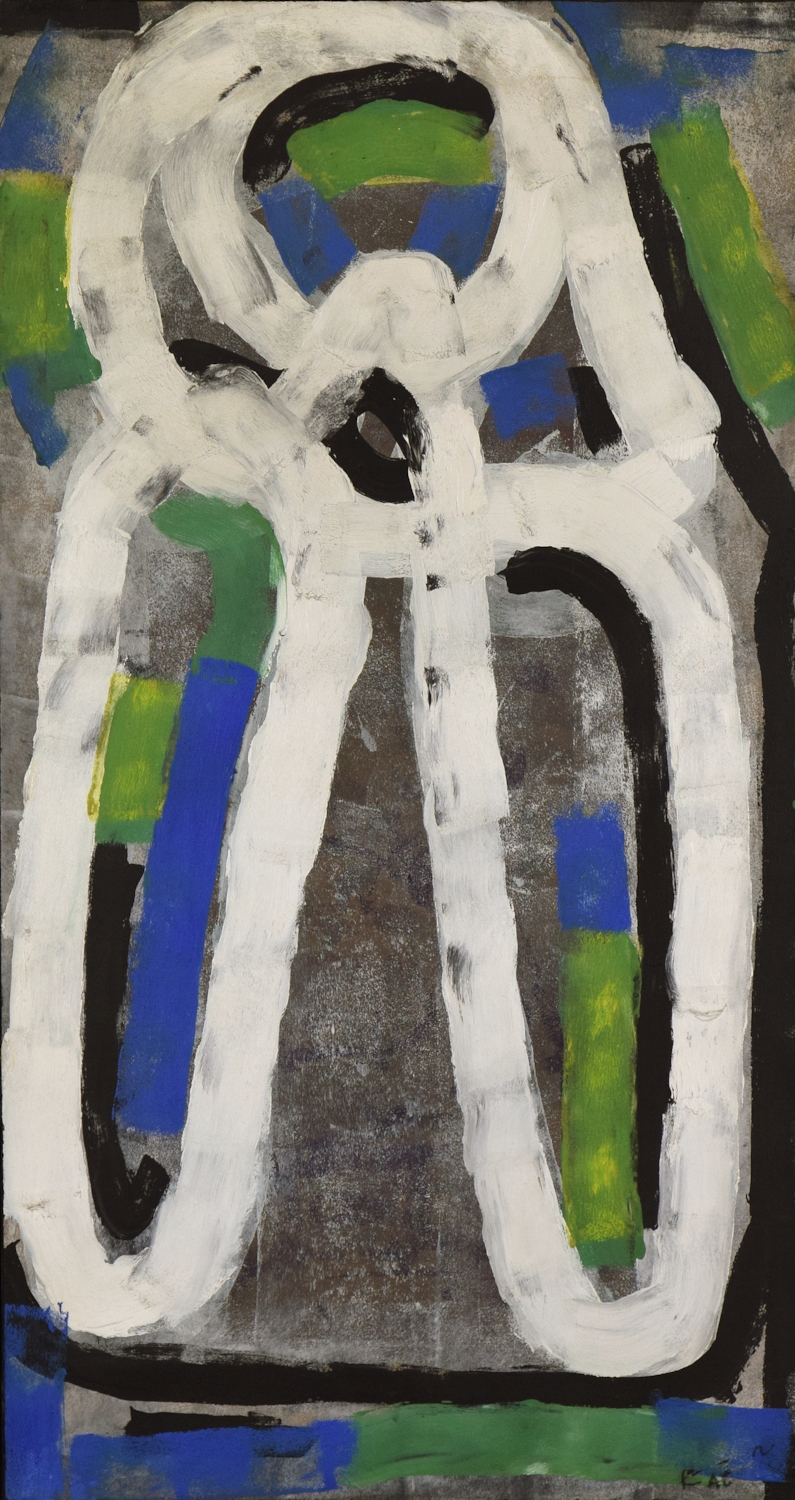
F. AC (Ficelle AC Bristol)
Acrylic on paper laid down on canvas
89.7 x 49.5 cm (35 ¹/₄ x 19 ¹/₂ inches)
89.7 x 49.5 cm (35 ¹/₄ x 19 ¹/₂ inches)
Georges Mathieu
1921 - 2012
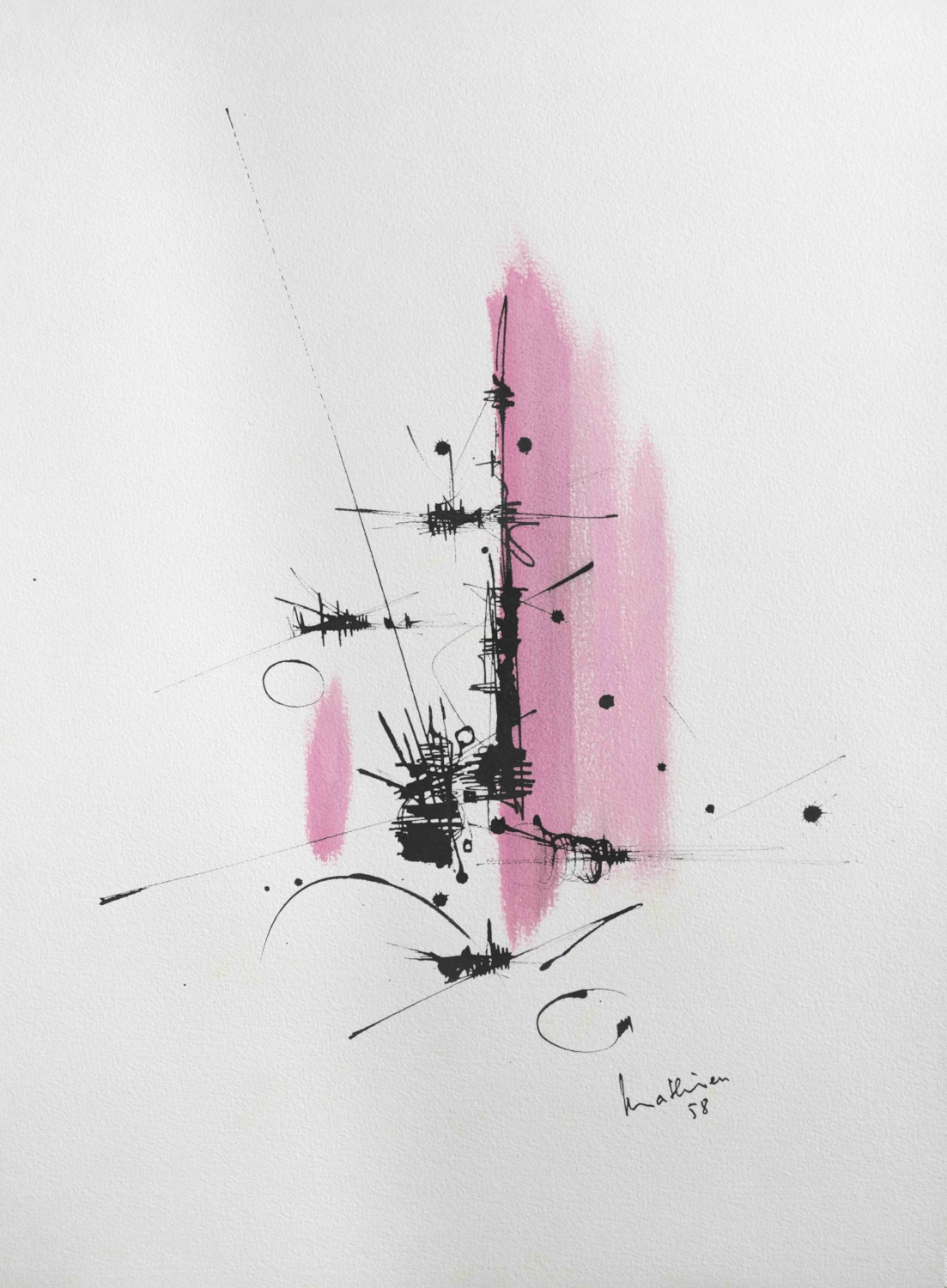
Composition
Watercolour and ink on paper
78 x 57.5 cm (30 ³/₄ x 22 ⁵/₈ inches)
78 x 57.5 cm (30 ³/₄ x 22 ⁵/₈ inches)

Yayoi Kusama
b. 1929
Visionary Wave Crest
Enamel and acrylic on canvas
65.5 x 80.5 cm (25 ³/₄ x 31 ³/₄ inches)
65.5 x 80.5 cm (25 ³/₄ x 31 ³/₄ inches)

